A new report dropped this week that should make every product manager pause and reconsider how they gather customer insights.
OneSignal's 2026 State of Customer Engagement Report reveals a seismic shift: 48% of marketers are already concerned about AI filtering deciding which messages reach customers—and 17% say it's actively impacting their deliverability right now.
This isn't a future problem. It's happening today.
When iOS 26 expanded notification summaries and Gmail started routing emails through Gemini before users even open their inbox, we entered a new reality. There's now a layer of AI infrastructure sitting between your product and your customers, making decisions about what signals get through.
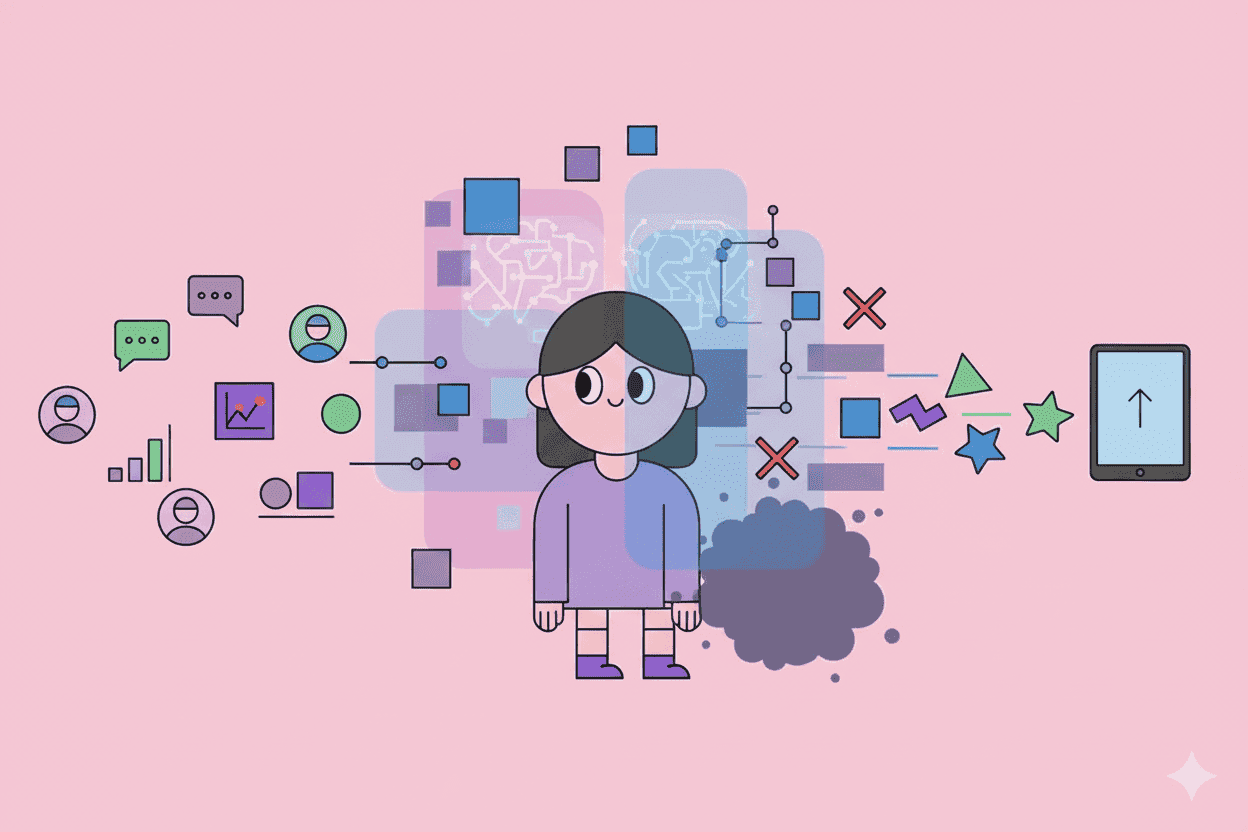
For product teams, this raises an uncomfortable question: If AI is filtering what your customers see from you, what else is it filtering about what you see from them?
The Signal-to-Noise Problem Just Got Harder
Product managers have always struggled with signal-to-noise in customer feedback. You've got support tickets, NPS surveys, sales call notes, social mentions, app reviews, and the occasional Slack message forwarded from a customer success rep. Most of it contradicts itself. Half of it is outdated by the time you read it.
Now add another layer of complexity: the feedback you're getting is increasingly pre-filtered by AI systems you don't control.
Think about it. Your customers' complaints might get summarized by their email client before they send them. Their app store reviews get weighted by engagement algorithms. Their support tickets get triaged and categorized by AI before a human ever reads them.
The raw signal—what customers actually think and feel—is getting processed, compressed, and filtered at every step.
Behavior Beats Broadcast
Here's the most striking finding from the OneSignal report: behavior-triggered messages outperform standard sends by 4-9x on click-through rate.
This isn't just a marketing insight. It's a product insight.
Messages that arrive because of something the customer just did—a search, a purchase, an abandoned step—earn attention in a way that scheduled broadcasts don't. They map to a moment the user is already in.
The same principle applies to how you gather customer insights.
Scheduled surveys sent at arbitrary intervals? They're becoming background noise. Another notification to swipe away. Another email for Gemini to summarize into oblivion.
But insights captured in context—when the customer is actively experiencing your product, when they've just encountered friction, when they've just had a success—those signals retain their fidelity.
The New Stack for Customer Understanding
According to recent data, 88% of companies are now using AI in at least one business function, up from 78% just a year ago. But here's the catch: 65% of teams say they're experimenting with AI in their workflows, while only 8% have fully operationalized it.
That gap is where product teams are getting stuck.
You know you need better customer insights. You know AI can help. But the path from "experimenting" to "operationalized" feels unclear.
The answer isn't to add more AI tools to your stack. It's to rethink the stack entirely.
Here's what the most effective product teams are doing differently:
1. Capturing Insights at the Source
Instead of relying on customers to articulate their feedback through surveys and tickets, leading teams are capturing signals where they originate: in calls, in chat, in usage patterns.
Sales calls contain pricing objections. Support conversations reveal usability gaps. Churn calls expose broken promises. All of this happens naturally, in context—but most of it never makes it into a format product teams can act on.
The shift is from asking "What did customers tell us?" to "What are customers showing us?"
2. Consolidating Fragmented Signals
The average product team has customer signals scattered across 6-8 different tools. CRM notes. Support tickets. Survey responses. Analytics events. Slack channels. Meeting transcripts.
None of these systems talk to each other. So the same insight—customers are confused about your pricing model, for example—might appear in fifteen different places but never get recognized as a pattern.
Consolidation isn't about creating a single database. It's about creating a single source of understanding. One place where signals from every source get synthesized into themes you can act on.
3. Making Insights Pull, Not Push
The old model: Someone on the team reads through feedback, creates a summary, shares it in a meeting, and hopes it influences the roadmap.
The new model: Insights surface automatically when they're relevant. When you're planning a new feature, you instantly see what customers have said about the problem space. When a theme crosses a threshold, stakeholders get notified.
This shift—from periodic reports to continuous intelligence—is what separates teams that stay close to customers from teams that gradually drift away.
The 30-Day Attention Window
Another finding from the OneSignal report deserves attention: 75.8% of teams say push notifications have the greatest impact on long-term retention in the first 30 days after install.
This maps directly to product discovery.
The first 30 days are when customers form their mental model of your product. When they discover core workflows or abandon them. When they hit their first moment of friction or their first moment of delight.
This window is when customer signals are richest—and most time-sensitive. A customer who struggled with onboarding two weeks ago has either figured it out or churned. That insight has an expiration date.
Yet most teams analyze customer feedback in batches. Monthly reviews. Quarterly analysis. Annual planning cycles.
By the time insights surface, the moment has passed.
Beyond the Feedback Loop
Here's the hard truth about customer feedback in 2026: the traditional feedback loop is breaking down.
Not because customers don't want to share. Not because product teams don't care. But because the infrastructure between you and your customers is getting smarter—and that smartness comes with filtering.
The solution isn't to fight the filters. It's to capture signals before they get filtered.
That means:
-
Listening to conversations, not just surveys. The richest customer insights happen in unstructured dialogue—calls, chats, support interactions. That's where customers tell you what they really think, not what they think you want to hear.
-
Analyzing behavior alongside words. What customers do is often more revealing than what they say. Usage patterns, feature adoption curves, and engagement sequences tell a story that surveys miss.
-
Synthesizing automatically, not manually. When signals come from dozens of sources and arrive continuously, human synthesis doesn't scale. AI should handle the pattern-matching and clustering, so humans can focus on the strategic decisions.
-
Connecting insights to action. An insight that lives in a dashboard nobody checks is worthless. Insights need to flow into the tools where decisions happen—your roadmap, your sprint planning, your stakeholder conversations.
The Product Team's AI Paradox
There's an irony here: AI is creating the filtering problem and AI is the solution to it.
The same technology that's deciding which notifications reach your customers can help you synthesize the signals that do get through. The same models that summarize emails before recipients read them can analyze call transcripts at scale.
But the direction matters. Consumer AI is optimizing for attention and convenience—filtering out anything that seems unimportant. Product AI should do the opposite: surface what matters, especially when it's uncomfortable.
The features your customers are quietly abandoning. The competitors they mention in sales calls. The moments of friction they've stopped complaining about because they've stopped expecting a fix.
That's what product teams need to see. Not the filtered, summarized, engagement-optimized version. The raw truth.
What This Means for Your Team
If you're a PM reading this and wondering what to do Monday morning, here's where to start:
Audit your signal sources. List every place customer feedback enters your company. Support, sales, success, reviews, social, surveys—all of it. Then ask: how much of this actually influences product decisions? For most teams, the answer is "less than we'd like."
Find your highest-fidelity signals. Not all feedback is equal. A churned customer's exit interview is more revealing than a happy customer's NPS score. A support conversation about a workaround is more valuable than a feature request in your backlog. Prioritize signals that are contextual, recent, and specific.
Close the loop faster. If it takes six weeks for customer feedback to influence a roadmap decision, you're operating on stale data. Look for ways to compress that cycle—weekly synthesis, automated alerting, direct connections between insights and planning tools.
Invest in synthesis, not just collection. You probably don't need more feedback. You need better ways to understand the feedback you have. That's where AI can help—not by replacing human judgment, but by handling the pattern-matching that humans can't do at scale.
The Future Belongs to the Customer-Obsessed
The companies that win in an AI-filtered world won't be the ones with the most data. They'll be the ones who maintain the clearest, most direct connection to what their customers actually experience.
When every message gets filtered, every notification gets summarized, and every signal gets compressed, the teams that preserve signal fidelity will have a massive advantage.
They'll know about problems before they become churn. They'll understand opportunities before they become obvious. They'll build products that feel like they were made by people who actually listen.
And they'll do it not by fighting the AI infrastructure layer—but by building their own intelligence layer on top of it.
That's the shift happening right now. That's what separates the teams that stay close to customers from the ones that gradually drift away.
Which one will yours be?